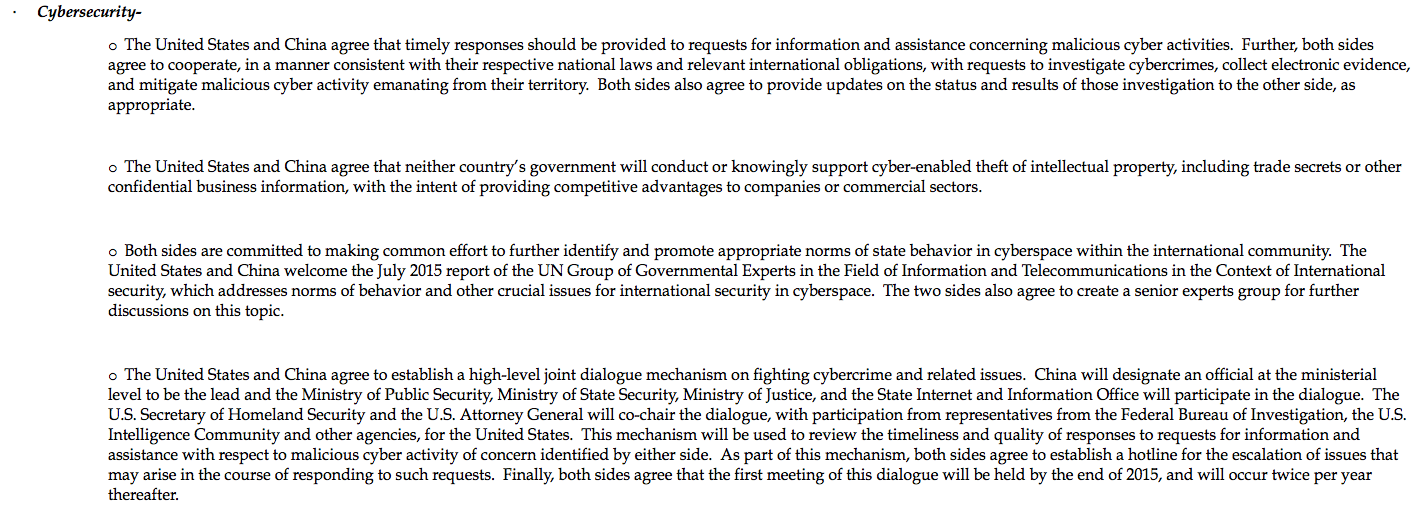
Xi/Obama's flawed cybersecurity agreement


The prevailing opinion, amongst my comrades here at Fidelis Cybersecurity, and other notables in the cyberdefense community is that this agreement is flawed, and only a half measure.  This will not stop or slow down the Chinese and their cyberspying campaigns.  Here's my initial take on the agreement below as well as some analysis:

The first, obvious question is: "Why should China stop what they have always emphatically denied doing?"  Moving behind this, though, the agreement limits the activities to “intent of providing competitive advantages to companies or commercial sectors”.  This doesn’t prohibit China for conducting cyber-espionage operations to benefit their military and people.  This could include, but not be limited to:
    • Energy exploration and production (particularly if China intends to use the energy on their south) -- think South China Sea.  They could spy on energy companies just to develop a situational awareness of activity around contested regions.
    • Healthcare/drug research particularly since China has an aging populace (that are now increasingly being affected by cancer and related conditions).
    • Transportation and logistics organizations to combat rising traffic and implement new means of moving goods and people across an expanding urbanization effort across China.
    • Higher-education institutions for new research (health, pollution, traffic, etc) and locations to launch attacks from (which they have done in the past).
    • Military intelligence and theft of IP related to schematics/plans for weaponry.
    • Spying on organizations and companies to understand how they conduct business.  China has conducted these types of "educational reconnaissance" spying operations in the past to understand how to work in a particular industry or field.
I don't expect to see a noticeable slow down of China state-sponsored cyber-espionage. Why would they just close up shop and stop their operations?  They've developed quite a highly-sophisticated methodology and organization to support their missions.  You may even see more of a focus on Asian and European companies

One thing the agreement doesn't mention is the cybersecurity pledge that China wants foreign businesses to sign?  Are they still going to pursue this?  Time will tell.

One potential scenario if China does choose to slow their espionage operations would be for it to use “proxy” groups, the same way that Iran and Russia operate.  It is easy to hide behind the "Great Firewall". Attribution is difficult with state-sponsored attacks because of the lack of physical evidence connecting the person to the "virtual".  China can always find a patsy within the country, arrest them and claim "mission accomplished" if they're caught by the US on a spying operation.
Another important point to note about this agreement is that even if both sides abided by it, it would never have stopped the OPM breach or their campaigns against health care providers or the defense industrial base.
Actions speak louder than words.  Time will tell if the words spoken in the West Wing are backed up by actions on the front lines of the silent cyber battlefield.

US CEO's meet Xi today

Hope they delivered a strong anti-cyber-espionage message.....


Oh, and I see several victims of APT attacks from China in this photo....

US Cyber Command in the crossfire with China cyber-espionage

This week, the US Cyber Command (USCYBERCOM) which oversees cybersecurity operations within the military, shared its new vision.  Admiral Michael Rogers detailed the plans and was quoted as saying:

“Our challenge is to protect the things we value -- freedom, liberty, prosperity, intellectual property and personal information -- without hindering the free flow of information that fosters growth and intellectual dynamism,”
This type of statement would normally not cause me to pause and think about what was said, except that there are some words you don't normally hear in military operations: intellectual property and personal information.  I don't think I can even pronounce dynamism, nor did I know what it meant until I google'd.

Reading a little further, the news release mentions:

Cyber Command is DoD’s warfighting arm in the cyber domain. DoD’s strategy calls for the command to defend DoD networks, systems and information, to defend the homeland against cyberattacks and to provide support to military and contingency operations.
Now we're getting somewhere, but what sort of scope could encompass defending the homeland? Some say the best defense, is a strong offense.  I am sure the men and women in USCYBERCOM are no strangers to conducting offensive operations, both on the battlefield and in cyberspace, but if they are going to go on the offensive, the consequences should be considered first.  Namely, a possible escalation and ratcheting of tension.   

Nation-State Cyber-Offensive Operations


Nation-state cyber-offensive operations typically fall into two areas: information gathering and destruction.  From an information gathering perspective, we could definitely use plans and historical data on the cyber-espionage operations from China.  The who, what, where, when how, etc.  This sort of intel could be invaluable to the government, military and private sector.  Imagine the vast amount of strategic and tactical that could be farmed through these operations.  Of course, it's not all about cybersecurity threat intel, USCYBERCOM could compromise the Chinese equivalent of OPM and distribute the identifies of operatives to the Five Eyes.  

From a destructive operational standpoint, this is risky business and probably not an option. Historically, Chinese state-sponsored cyber-espionage has been focused on information gathering. By destroying digital infrastructure in mainland China, the US would probably cross a "red line" and the Chinese would be compelled to retaliate.  Given the fact that the US critical infrastructure is continually getting hammered, this could be a real possibility.

Legal?


Were USCYBERCOM to start conducting offensive operations against nation states in order to "defend the homeland", can they do this legally?  Consider the National Defense Authorization Act of 2011:

    SEC. 954. MILITARY ACTIVITIES IN CYBERSPACE.

       Congress affirms that the Department of Defense has the 
     capability, and upon direction by the President may conduct 
     offensive operations in cyberspace to defend our Nation, 
     Allies and interests, subject to--
       (1) the policy principles and legal regimes that the 
     Department follows for kinetic capabilities, including the 
     law of armed conflict; and
       (2) the War Powers Resolution (50 U.S.C. 1541 et seq.).

If USCYBERCOM says they're going to protect our IP and personal information, which are both considered national interests, it sounds like they'll have the charter do conduct operations.

The command must also work with partners in the government and in private industry to deter, detect and respond to attacks, many of which occur against critical infrastructure in commercial hands.
This could put USCYBERCOM right into the line of fire between Chinese state sponsored cyber-espionage and the private sector.  The question is, what are the next steps and are they ready for it? Will USCYBERCOM partner with the NSA for increased surveillance at our electronic borders? Will they be primary incident responders for gov't and military agencies?  How will they foster cooperation and partnerships with the private sector?  If they're protecting IP and personal information, will this extended past the defense industrial base? 

On a final note, my message to Adm. Rogers is: I'm ready to partner.

I'd love to hear your thoughts.

- @jbharvey 09.09.2015

PS - Shout out to @timstarks for the heads up.

Taming the Tiger: Domestic and foreign policy complexities in curbing China's cyber-espionage campaign


I was reading a good article by Oliver Berg and was inspired to write an article on the situation we have with China over cyber-espionage and the United States' [possible] response.

From the article, two quotes and statistics really stood out:

The budget to support the U.S. government's cybersecurity efforts is $14 billion for fiscal 2016, about 10 percent more than the $12.5 billion the government budgeted for 2015. Despite this increased spending, the U.S. is still vulnerable to attack.
"One of the conclusions we've reached is that we need to be a bit more public about our responses, and one reason is deterrence," said a senior administration official in a recent comment to the Times. "We need to disrupt and deter what our adversaries are doing in cyberspace, and that means you need a full range of tools to tailor a response."

A Brief History


Given our economic reliance on China, at this point there's probably nothing short of a kinetic response that is going to stop the Chinese from performing the operations. Consider this timeline:
Similarities in US and Chinese military aircraft.

Meanwhile, dozens of high profile cyber-espionage operations were being conducted by China against US commercial interests and most recently: critical Federal agencies.  BTW, CSIS has a great list of significant breaches since 2006, check it out.

For years China has undertaken a systematic process to extract intellectual property and state secrets from the United States in direct support of their five year plans.


Rumors of White House Sanctions


Now it's September 2015 and Xi Jinping is set to come to the United States. There have been rumblings of sanctions put in place by the White House, that could be announced as early as next week prior to Xi's visit. It is widely speculated how deep the sanctions will go, and if they will be against Chinese corporations suspected to have benefited from cyber-espionage campaigns or if they will be targeted against China itself. I believe it will probably be the former.

The issue with sanctions that target the nation-state of China is that it could hurt the US domestic economy. With this being an election year and the economy going through a rough patch (although we are recovering), the likelihood that deep-cutting sanctions will be implemented AND be effective is quite low (I'll explain).

There have been talks in the past about the possibility of the United States making a formal complaint to the World Trade Organization.   There are political and legal experts making the argument that this would be a preferable route to US-imposed sanctions:

The unilateral imposition of U.S. sanctions would have less global legitimacy at the outset than if they were imposed pursuant to authorization by the Dispute Settlement Body of the WTO. - Stuart S. Malawer on Chinese Economic Cyber Espionage: U.S. Litigation in the WTO and Other DiplomaticRemedies

China Trade By The Numbers


China is a cornerstone to the US economy.  According to data supplied by US Census Bureau, the United States imported over $466B worth of goods from China in 2014.  In 2005, this number was $243B, which represents a Compound Annual Growth Rate of 7.5%.    That means every year, Americans are expanding their purchases and utilization of Chinese manufactured goods.  Compare this with the US exports to China over the same period, 12.99%.  Visually, here's the historical data from 1985 to 2014 I threw into Tableau for a little eye candy:

China Imports and Exports

The US import of trade-goods from China outranks every other nation in the world.  From an export perspective, China ranks #3, behind Canada and Mexico.  Suffice to say, China is pivotal to the success and stability of our economy.  I haven't even scratched the surface about the effect that US-China trade has on the global economy, but this was evident during the market correction of August 2015.

Sanction Effectiveness


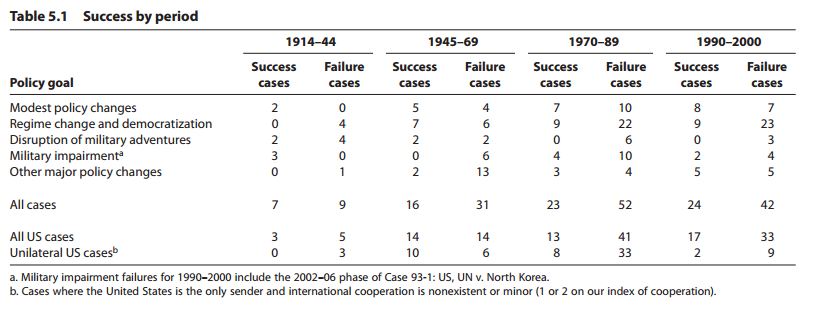
On the subject of sanctions and metrics around their success, there is a great book Economic Sanctions Reconsidered by Gary Clyde Hufbauer et al. In this book, Mr. Hufbauer analyzes sanctions and provides some outcome results. See the below results as linked from Financial Times article by John McDermott:


Economic Sanctions Success Data

According to this data, the US got a little bit better from 1990-2000 on the success of sanctions, but was still only successful in 57% of the cases. If the proposed sanctions vs. China to get them to stop cyber-espionage campaigns against us are considered "modest policy changes", we may have a shot...but if it's classified as "disruption of military adventures", we are in trouble, a sanction of that type hasn't been successful since the 1945-1969 time period.

Tactical Response


What the US needs to do is figure out how to accelerate (and encourage) government agencies and commercial organizations to bolster their cyber-defense (NOT cyber-defense prevention) capabilities.
This boils down to two main areas:


Invest in the people.  There is a major cyber security skills shortage.  Today, security is more about the knowledge and experience of the people, than having the best and latest technology.  Certainly, the appropriate technology can enhance an organization's posture, but you still need the people to back it up.  The technology should work for the people, not the other way around.  

One way the government and commercial organizations can close the infosec skills shortage gap is focusing on our youth.   Organizations like 1nterrupt and CyberPatriots have sprung up looking to educate and train high school kids on hacking and response techniques. 

Focus on detection and response. In our industry, there is a term "dwell time", which is the time spent by an attacker in a network before they are discovered. According to Mandiant, in 2014 the average dwell time for targeted attacks was 205 days. Every analyst and responder's job should be to narrow that gap between initial compromise and discovery, this is known as reducing the gap.

If the largest corporations and governments, who spend millions on their network prevention security infrastructure, continue to get breached, perhaps it is time to adopt a new model? The model that these organizations need to adopt is one of assuming continuous compromise, meaning assume you are constantly getting breached, and work to invest in detection and response technology vs. preventative measures. 

It is clear from this report to Congress on the Target breach, that the problem is bigger than just technology. Target had spent millions of dollars on security infrastructure, but without equal focus on people and an effective detection/response strategy, you are going to get breached. 

Final Thoughts


It is clear that there is no easy solution in sight to force China to stop it's systematic vacuuming of intellectual property from the US.  Or as General Keith Alexander said: "the greatest transfer of wealth in history".  There is plenty of criticism to go around but no solutions, especially from presidential candidates:

Chinaaaaaaaaaaaaa!

“There's no question that China is a rising adversary. There is no question they have cheated on trade agreements. There's no question they have engaged in cyber espionage and cyberattacks for a long time. It is ineptitude, by the way, that the Office of Personnel Management couldn't detect and repel that attack.” - Carly Fiorina

"Given China’s massive cyber attacks against America, its militarization of the South ChinaSea, continued state interference with its economy, and persistent persecution of Christians and human rights activists, President Obama needs to cancel the state visit," - Scott Walker

"I've been talking about China for years. Because China's going bad it's going to bring us down, too, because we're so heavily coupled with China, I'm the one that says you better start un-coupling from China because China's got problems." - Donald Trump


Given our dependence on Chinese manufactured goods, there may not be much that the United States can do to curb or curtail the escalating cyber-attacks from the Middle Kingdom. Congress and the White House should develop (or accelerate) plans to focus economic interests in other countries.

Whether it be Mexico, Brazil, India or even in our backyard, the United States needs to focus on becoming less dependent on China for our cheap Walmart goods, as well as our technology manufacturing.  If not for putting all of our economic import eggs in one big basket, at least do it for national security's sake.

- @jbharvey 09.08.15

Interesting Hillary email

Thought I would go and check out the Hillary Clinton (HC) email search site: https://foia.state.gov/Search/Results.aspx?collection=Clinton_Email

Mark Penn advised HC on Nov 28 2010:


The relevant quote is:


"I think you need to order a full scale review and upgrading of the cyber security of the state department immediately."

and:

"No State department can operate if it can't keep its own classified cables and internal orders confidential..."